First reflection
What struck me was the convergence with the pilgrimage. The urgency to join them. All I could manage was the last stretch before they approached the dojo. Then dropping into the pilgrimage space as if I had been walking along with them all along, from the very start. And in a way, I had been. Perhaps my walk didn’t have Kemble or Cookham as a backdrop… but in some other ways, it did. The exhaustion, the sore bits of the body, the luck of the draw, life unfolding beyond control, the kindness of strangers, the discomfort, the sheer intensity of it all. I, too, felt tired from this long journey I had been on, but like the pilgrims, I felt a sense of awe and elation at what I had discovered about the world, about others, and about my own heart-mind. As the little river joins the big river, there is joy to be found. Tears of joy at this confluence, this meeting of ways, my Zenway, our Zen ways – to recognise together that, bloody hell, it’s been hard! But my goodness, what a ride it’s been! And it’s still going! It’s still going!
Meishin
Second reflection
As I cycled to the dojo on Tuesday evening, the sky was intensely blue, with stark white, light grey and dark grey cloud formations. They had been painted there for this evening’s ceremony. A fresh, cool breeze greeted my face and, as I looked up, the sun shone through, warm and bright in the dramatic skyscape. As the clouds moved in the sky, everything felt dynamic, playful and yet calm, serene, as if everything was in its place. A bright evening full of character – so fitting for what I was about to learn about the life of Shinzan Roshi, our teacher’s teacher.
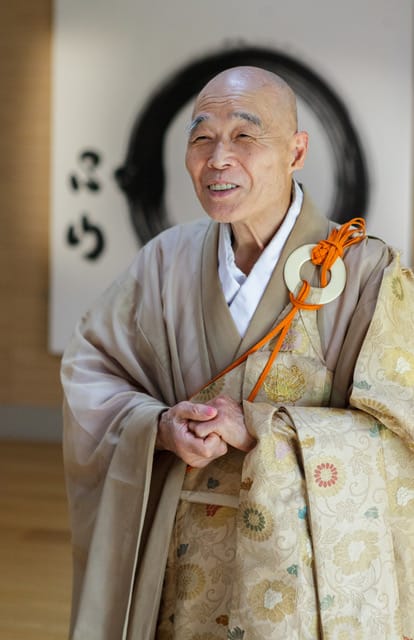
Shinkai Roshi described his experience of his teacher, Shinzai Roshi, back at the temple in Japan. It was a chaotic place, full of people who had been excluded by society, people who had been struggling, failing, or finding their way at the edges of life. Failure had characterised and marked Shinzan Roshi’s life too, and perhaps because of this, he seemed to attract people who had struggled and failed in life. What stayed with me was the honesty of Shinzai’s account. There was no attempt to make practice sound smooth or elevated. It was ordinary life, difficult life, messy life, being met directly.
This really struck me. It struck me because it is at the heart of so many of the challenges I face in my own day-to-day life: difficult people, intrusive people, people who are struggling with control, with self-worth, with needing to be seen. How can I meet them where they are? How can I hold and feel my own reactions without immediately snapping back, defending myself, withdrawing, or drifting into fantasy? How can I dance the dance? Not recoil, not harden, not disappear, but be with it. The Buddha of the moment.
There was another part of the story of Shinzan Roshi that stayed with me too: his ability to shift from gardener, to dog walker, to ceremonial Zen Master. He wanted his students, and Zen itself, to be out in the world, not closed up in a temple. To bring Zen to lay people. To make life our practice. Nari kiru, nari kiru, nari kiru.
I will remember this of Shinzan Roshi: nari kiru – actualisation, making life our practice moment by moment; senshin – purifying the heart; shugo – preserver of stupidity, preserver of the fool; calligraphy – dharma through characters and ink.
And I will remember this too: failure does not matter in the way we think it does. Failure may be a door opener. Failure may be the mud from which the lotus grows. And so, it is all right. We are just fine as we are. We do not need to be better before we begin. We are luminous, powerful, loving, immense beings – just like that, just now, just this.
Meishin