When I was a child, I wanted to be a ninja.
I was interested in martial arts, and I liked the idea of sneaking off in the darkness of night to go on secret missions where I could use my deadly martial arts skills in the service of some presumably important, though undefined, larger purpose. The prospect of years of training to master skills known only by a handful of people was deeply appealing to me at that time… and, to be honest, still is.
In retrospect, I think I was drawn to the extraordinary because I wasn’t very good at being ordinary. Growing up with undiagnosed autism, I had clear strengths in certain areas – mathematics, computers, learning enormous amounts about topics that interested me – but I was pretty hopeless at social interaction. I didn’t fit in, and although I did make a handful of friends over the years (some of whom I’m still in touch with), I quickly learnt that groups of unfamiliar people were not safe to be around. So, if it just so happened that my dream career would require me to spend most of my life in the shadows, away from people, well, so be it. (In later life I learnt that the historical ninja were much more like modern-day spies, who have to have excellent social skills in order to pull off their cover stories, but fortunately as a child I was unburdened with inconvenient facts.)
My interest in the martial arts led me into the world of spirituality. I would read books about Japanese and Chinese martial arts which usually had a short, obscure chapter toward the end which talked about meditation in terms that were either pretty vague or beyond my comprehension at the time; I didn’t really have much idea what they were talking about, but I came away with the clear idea that meditation was something important that I should definitely get into at some point. Still, at that age I was more interested in flying kicks, so it was quite a while before I decided to engage with a spiritual tradition directly, as opposed to through the proxy of martial arts training.
Eventually, though, I started to realise that, while my Kung Fu and Tai Chi teachers were amazing martial arts, neither was providing the Mr Miyagi-like spiritual guidance I was hoping for, and so I decided to take a more direct interest in Buddhism. (I was also interested in Daoism, having found the Dao De Jing and the writings of Zhuangzi through my Tai Chi practice, but when I was looking around for a way in to start a practice of my own, Buddhism got there first.) I started listening to podcasts, hearing interviews with teachers and Dharma talks, then began buying books by the armful. Soon, after a few failed attempts to start a daily meditation practice of my own, I decided to sign up for a Zen retreat with the Western Chan Fellowship.
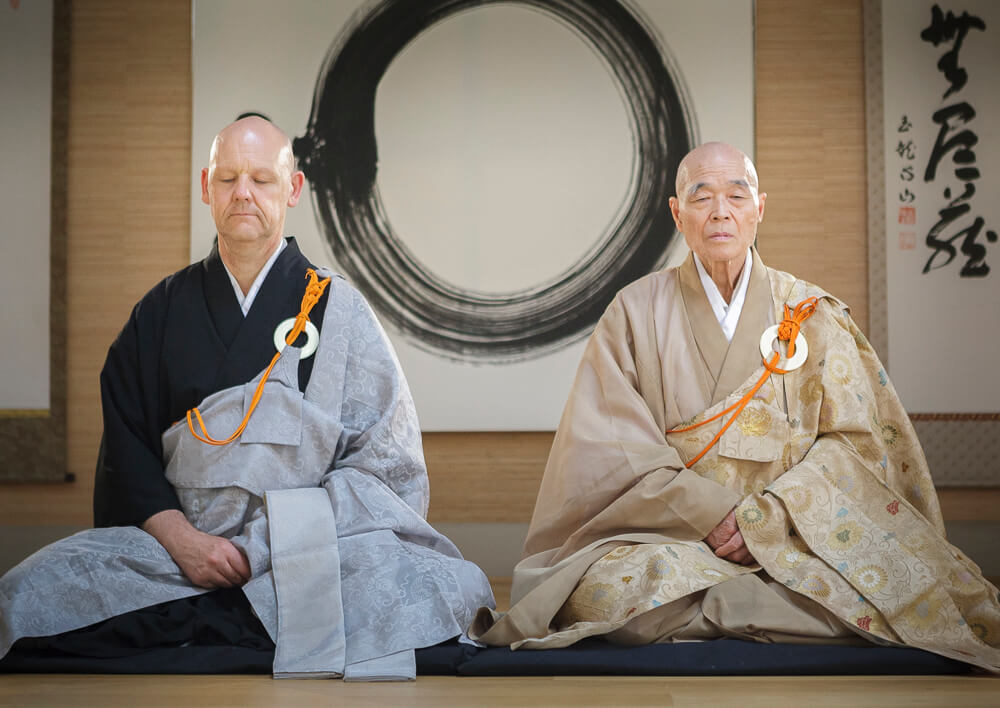
I was very drawn to Zen. It seemed to have a lot in common with the Daoism that intrigued me, but had its own library of cryptic, mysterious, intriguing texts. The Western Chan Fellowship offered two major practices, both of which will be familiar to Zenways students: Silent Illumination, a ‘just sitting’ practice equivalent to ‘Resting in the Unborn’; and working with a hua tou, the key phrase of a gong’an, or koan. Of the two methods, the hua tou made sense to me, whereas Silent Illumination seemed totally impenetrable – so, naturally, I decided to take up Silent Illumination.
On some level it felt like learning Silent Illumination was what I most needed, deep down. I already knew how to work hard; I was raised to make the most of my intelligence, bringing home top marks and awards for my parents to show off to their friends. In my twenties I spent a lot of time in rapid reaction roles, becoming adept at working long hours to pull rabbits out of hats in the nick of time. Throwing myself into intensive koan study would perhaps have been the most natural thing in the world. Instead, though, I was mysteriously drawn to this idea of ‘just sitting’. I didn’t even know what it meant. What was I supposed to do in order to ‘just sit’? I kept waiting for the next instruction, but it never came. A couple of times I reported some interesting experience to the teacher and what I was planning to do with it in my next practice session, and he would just gently advise me to set that aside and approach my present-moment experience with no particular idea or expectation in mind. At the time, I would nod dutifully and thank him for his advice, then go back to trying to figure out what I was supposed to be doing to make the next interesting thing happen on the cushion.
In the end, it was too much for me to tackle head-on. I simply couldn’t ‘just sit’. After several years of daily practice which felt like banging my head against a brick wall – a practice which, I have to say, gave me a tremendous resilience and willingness to just keep going no matter what, which has had an enormous impact on my life both for good and for bad – I decided to jump ship on this whole Zen thing.
I attended a retreat with a teacher in the early Buddhist tradition, Leigh Brasington. Leigh’s approach to teaching was clear and methodical, with step-by-step instructions to be followed. I had no idea how to ‘just sit’, but I knew how to follow instructions! That retreat was a real turning point in my practice; it opened things up for me in profound ways, and my relationship to practice shifted from ‘This feels important even if I can’t really say why’ to ‘This has changed my life.’
That wasn’t the end of the road for my relationship with Zen, though. I continued to sit retreats with Leigh every year, learning a wide variety of technical meditation skills and having all kinds of interesting experiences. In effect, the practice was opening up exactly the ‘extraordinary’ side of life that had drawn me to it in the first place. Those strange, cryptic texts started to seem more poetic than cryptic, an attempt to capture in words something which is ultimately beyond them. I worked hard, sat long hours on long retreats, and tried out every insight practice I could get my hands on.
Then, at the tail end of a month-long retreat with Leigh at the Cloud Mountain retreat centre in America, something shifted for me. I went up to a secluded spot with a nice view of the surrounding forests, sat down, and let go. After a while, I realised I was ‘just sitting’. I still can’t put into words what exactly had changed – why I could never understand the practice before, or what shifted to enable me to ‘get it’ – but suddenly everything I’d been taught about Silent Illumination made sense. It was as if my Zen practice had been patiently waiting in the wings for all those years until I was finally ready to come back to it. Since then and to this day, some version of Silent Illumination has been one of my core practices and is in many ways my favourite. (I sometimes half-jokingly tell my students that there’s no ‘best’ meditation practice, but if there were, it would definitely be Silent Illumination.)
If the first part of my practice arc was about discovering the extraordinary, in more recent years it’s been much more about coming back down to earth. First, my teacher went through some serious health challenges, and for a while it looked as if he might have reached the end of his life. (Thankfully, he recovered and is still going strong at the time of writing.) At around the same time, I trained as a meditation and mindfulness teacher with Zenways, and then started a weekly drop-in class as well as teaching multiple eight-week courses. Getting into meditation teaching has been one of the most rewarding experiences of my life, but also one of the most challenging, bringing to the forefront all of those social interaction issues rooted in childhood.
In 2018 I had a pretty tough year. I’d only recently started teaching, and my day job was going through an incredibly intense period. Then, out of the blue, a friend and colleague, Rich, died unexpectedly of a heart condition. I was there when the police broke down Rich’s front door and found him. A couple of weeks later, still emotionally numb, I went straight from Rich’s funeral to a ten-day silent retreat which had been booked months earlier. The retreat was supposed to be with my teacher, so under other circumstances I would have had some interview time coming up with my trusted mentor, but due to his health problems the retreat was instead being taught by two other teachers, neither of whom I knew at all. Trust comes slowly to me, so this made the retreat environment pretty challenging.
On that retreat I tried every trick in the book to get my grief to go away. I hit it with loving kindness, compassion, equanimity, contentment, deep concentration states, deconstructive insight practices – you name it. None of it worked. In the end, on about the fifth day, I reached the end of my tether and simply gave up. I just sat there on my meditation cushion, like a lump, not ‘meditating’ at all. I just sat there, and finally let myself experience the pain. People who’ve been doing this practice for a while won’t be surprised to hear that that was the point at which it finally started to shift, but, for the avoidance of doubt, this wasn’t just another clever trick to make the pain go away. It was a genuine, total surrender, a complete giving up of any and all attempt to ‘meditate through it’.
For better or worse, that experience seemed to open the floodgates, and a lifetime of difficult emotions started bubbling up to the surface. I remember telling one of the teachers toward the end of the retreat that my whole heart area felt like it had been pounded with a tenderising mallet. And over the years that have followed, there’s been plenty more where that’s come from.
Wind forward to the present day, and what’s foremost in my practice is the utter ordinariness of my life. My practice continues to deliver insights, but whereas early on they were of the exciting, dramatic, cosmic variety, today’s insights typically sound utterly obvious and common-sense when I try to put them into words. (The difference, of course, is that now I know them for myself, rather than merely having heard them from someone else – and that makes all the difference.)
Life has also delivered a steady stream of challenges to keep me on my toes. We’ve had the COVID-19 pandemic. Then, just when the world was starting to open up again, my father was diagnosed with late-stage terminal cancer and died just a few weeks later. Since then, my mother has been adjusting to living on her own and having some challenges along the way. I’ve had to give up my weekly meditation class in order to free up the time and energy to visit more often and help out where I can. I’ve moved jobs after a project that was very dear to me closed down, and I haven’t fully found my new niche yet. I’m getting older, and my body isn’t working quite as well as it used to. I get migraines. On and on it goes.
Just recently I attended a Zen retreat with a Soto teacher, and commented that, with everything going on at the moment, my ‘just sitting’ practice sometimes feels like I’m simply doing my best not to make things worse than they already are! It’s a far cry from the early days of practice when I was drawn to cosmic truths and deep mysteries; now, it’s more about just being here, doing my best to feel what I’m feeling rather than trying to bury it. The quest to transcend my mundane present-moment experience has become a quest to accept it – and that means accepting myself, too.
Early on, I saw spirituality as a path of transformation that would allow me to ‘fix’ all the problematic bits about myself. I thought practice might make me all cool and non-reactive like the Zen masters in the old stories, rather than the hypersensitive, easily irritated person that I really am. Now, it seems much more to be about simply accepting that this particular mind and body are sensitive, and not trying to be something I’m not. I’m starting to suspect that practice doesn’t so much change us into different people as it does free us up to be more completely who we already are, and that the ultimate value of a meditation practice is not so much the access to uniquely spiritual insights as it is the willingness to accept the situation we find ourselves in and make the best of it, finally able to let go of the secret belief that there’s a better way to be, a better version of myself that I should be, if only I could work a little bit harder.
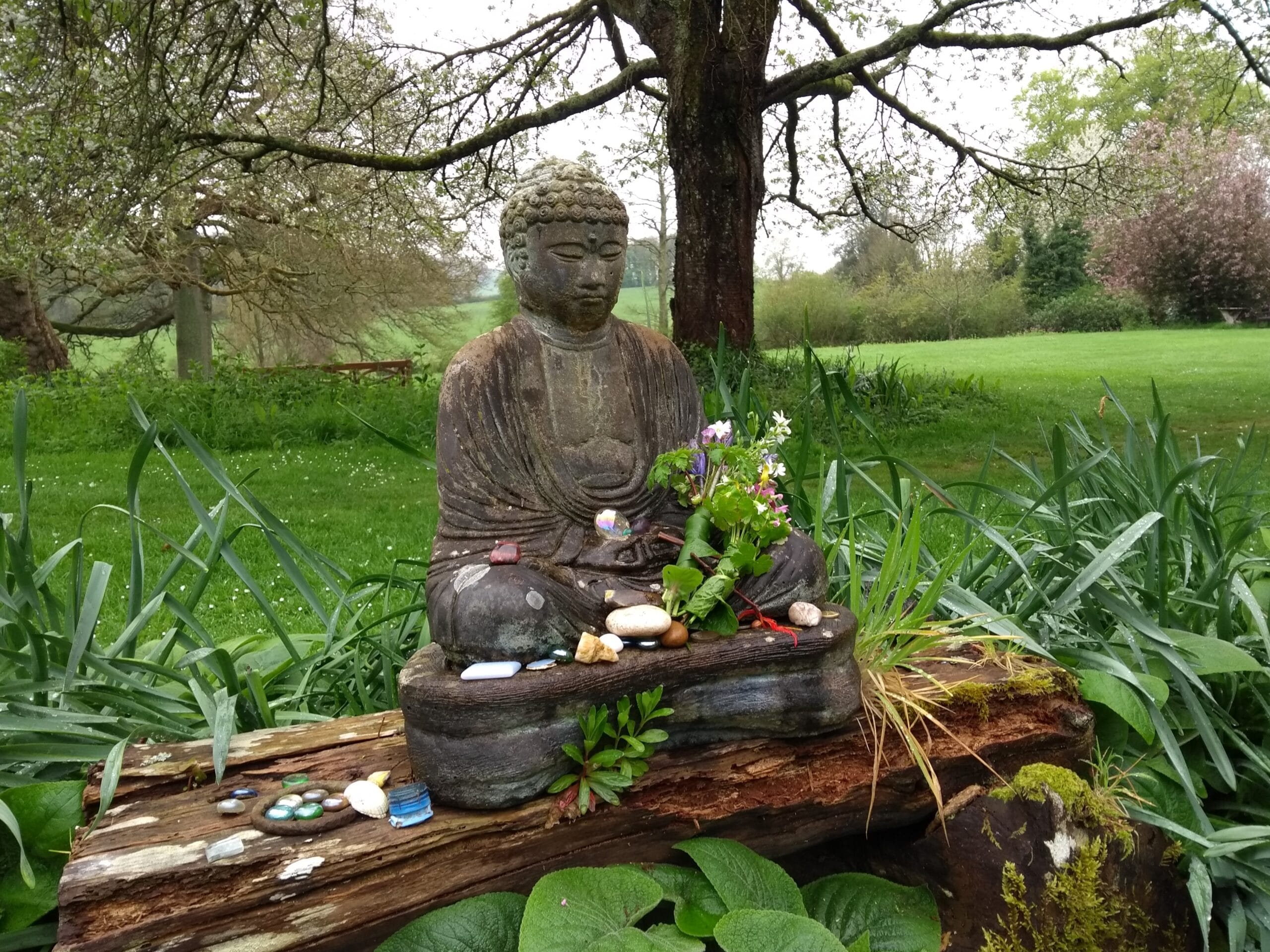
Friends. Family. Good food. Watching the trees dance in the wind. The way the sun lights up the trees early in the morning at this time of year. Pain, sadness, grief, frustration, disappointment. Laughter. The ingredients of an ordinary life. Nothing special at all; and yet each moment is one of a kind, never to return, complete in itself. Experience, flowing on, moment by moment.
That’s all.