Case 20 of the Book of serenity – Dizang’s Not Knowing.
Dizang asked Fayan, “where are you going?”
Fayan said, “Around on pilgrimage “
Dizang said, “What is the purpose of pilgrimage?”
Fayan said, “I don’t know.”
Dizang said, “Not knowing is most intimate” (Fayan had an immediate great awakening)
From the moment I read in a Zenways email that they were organising a pilgrimage, I thought, “I am in!” I had always fancied doing one. The idea of walking day after day, disconnected from everyday life — an adventure, a physical challenge, being outside my comfort zone — all of it appealed to me.
It all turned out to be true, but so much more happened.
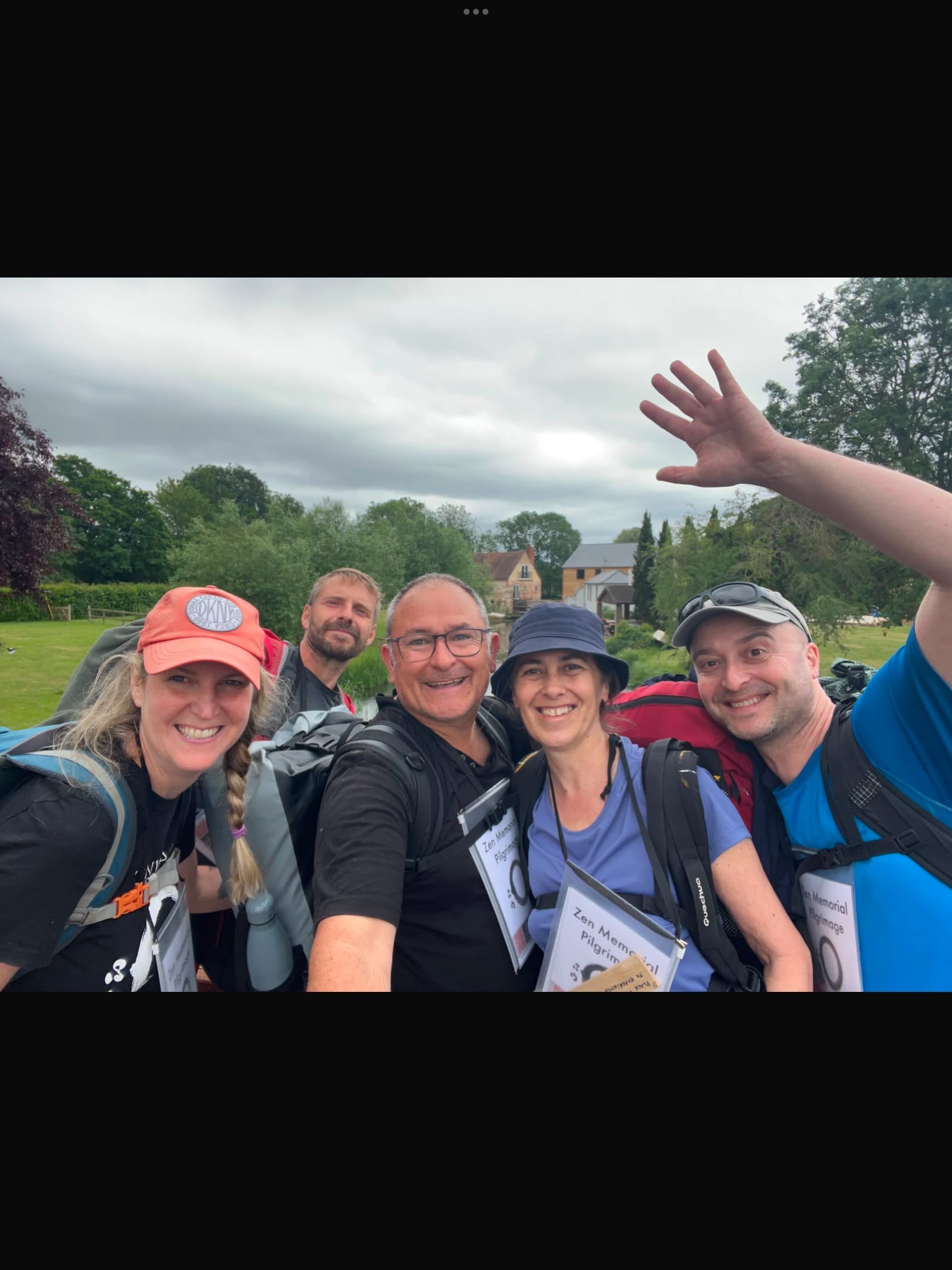
After my first Zoom call with Sean and Riccardo, I discovered how the pilgrimage was going to work: walking with no money and no food, with signs around our necks making it very clear that we were on a pilgrimage.
I am French, and food is deeply ingrained in the culture I come from. It is more than food. There is a reverence to it; it is discussed, anticipated, taken seriously. So the thought of not having food secured during the walk was very confronting. I had an inner battle about it, but I never considered not going.
I prepared as best I could. I trained a little, walking the streets of London with a heavy backpack, and bought and borrowed what I needed. I am not a camper and had only ever done day hikes.
Then the day came. I left my flat, went to Paddington Station, and headed for Kemble in the Cotswolds to meet my fellow pilgrims.
Five of us walked the route for twelve days. Others joined for a day or two, and one person for the first five days. Most were strangers to me. I had met a couple at a BZR and Sean through a few Zoom calls.
Off we went, and very quickly the sign was around my neck. I felt the discomfort of being made visible.
We chanted the Heart Sutra at the source of the Thames then began to walk.
One foot in front of the other. That is all I need to do.
After about an hour, we found our first sign of the River Thames: a puddle. We stopped to collect some of the water, shared the first teaching from Shinzan Roshi, and continued on our way.
Hour after hour, with nothing else to do but walk, I became open to the people we met. Hundreds of strangers: men and women, young and old, rich and poor. We smiled and said hello. Sometimes we stopped and talked. They were intrigued by the signs around our necks.
For the first day or two, I would go to Sean and ask him to explain what our pilgrimage was all about. Gradually, I found my own voice.
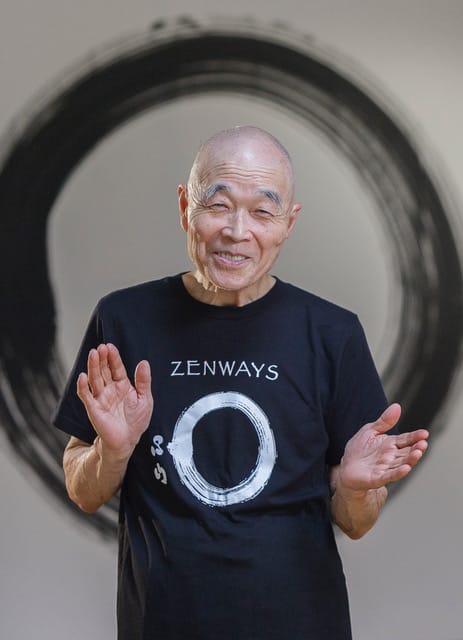
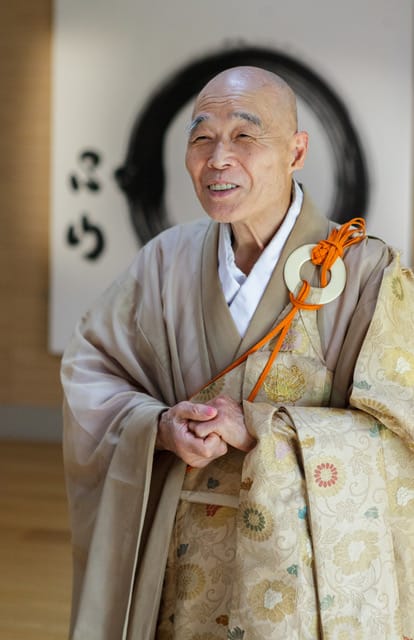
Shinzan Roshi’s lovely smiling face was on our sign. I explained that we were walking in memory of our teacher’s teacher, this little Japanese man who had died only five years earlier. We were walking from the source of the Thames into London, to our Zen centre in Camberwell, in a traditional Zen way, without carrying food or money.
Sometimes the conversations were long, and some of the faces are forever imprinted in my memory. We occasionally exchanged hugs. Sometimes there was only a smile and a hello.
As we walked, I became more and more open, more and more free from my usual hang-ups.
Just walking. Just smiling. No hiding. Not demanding anything. Just being.
There was also something about having nothing extra. We had no money, no food, and very little beyond what we carried on our backs.
In a way, we were walking naked.
Our personalities were still there — our particularities, our habits, our fears, our humour — but there was less and less to hide behind.
Nothing extra.
Just ourselves, walking together, open to whatever came.
At the end of the first day, I sat outside a shop with my sign saying:
On a Zen pilgrimage. Donation of food gratefully received.
Again, I felt confronted. How should I sit? Should I look up or down?
Eventually, I settled into simply being there, open and friendly, but not asking or demanding anything.
And every time, food was donated.
Sometimes people also gave us money.
It was a strange experience: people being kind and generous simply because they wanted to be.
I was learning to receive. And give back what I didn’t need, nothing extra.
I have always been more than happy to give. Receiving was something different. And somewhere along the way, I began to feel something I had perhaps never felt so deeply before: that I was worthy of love and kindness.
That realisation still makes me emotional.
We slept every night in a different place, again receiving the kindness and generosity of strangers — in village halls, church halls, a church one night, and sometimes in people’s homes. Sometimes we were fed; sometimes we weren’t. But we always had enough.
Some days were long. We had blisters and tired legs, but we laughed a lot.
Our weird little group became one. We remained completely ourselves, with all our different personalities and traits, but something flowed between us. Love flowed through each of us, between us, and through the common humanity of all the strangers we met.
There were often tears, moved by the recognition of our shared humanity.
And Shinzan Roshi was with us every step of the way.
Each morning, one of us read one of his teachings and they spoke about it for a little while. Then we carried it with us through the day. His words were with us when we spoke to the people along the way.
I never met his physical body, but I felt his teaching through Daizan, and then all the way back to the Buddha.
I was on a Zen pilgrimage.
When we finally arrived in London, a huge flow of emotion ran through me.
We had just walked.
What happened?
There is still a mystery to it. Something happened.
I could feel it in my fellow pilgrims too. Something had happened between us: a sense of being forever united in our oneness, and in our oneness with the world around us — with no separation, and yet completely unique, all at once.
It has been around three months now.
Life is interesting. All my stuff is still there, but somehow it feels a little lighter, less tight.
I think about the water we walked alongside: from the first tiny puddle in the Cotswolds, becoming streams and rivers, then the big, mighty Thames as we entered London, and finally flowing into the sea.
The same water, always changing, always moving, always different, and yet always the same.
The pilgrimage carries on.
The hero’s journey, always changing, always moving.
Nothing extra. Nothing to change.