Taitoku – the difference between seeing and becoming
If you work with people’s inner worlds, whether as a therapist, a coach, a mindfulness teacher, or in any caring or facilitative role, you will know the moment well. A client arrives at an insight. Something clicks. They see their pattern clearly, perhaps for the first time, and there is real light in the room. And then, weeks later, they are living inside the same pattern as if the insight had never happened.
The understanding was genuine. So why did so little change?
This question sits at the heart of a short teaching that Daizan Roshi, the founder of Zenways, recorded recently in answer to a deceptively simple question someone had put to him: what is embodiment? His response opens up something many experienced practitioners sense but rarely have language for, and it points towards what we at Zenways have come to call The Embodied Mindfulness Way.
Realisation is nothing, actualisation is everything
Daizan’s teacher in Japan, Zen Master Shinzan, had an English phrase he often repeated:
Realisation is nothing; actualisation is everything.
It is a startling thing for a meditation teacher to say. Are we not in the business of realisation, of insight, of helping people see freshly? Daizan’s point is not that insight is worthless. It is that insight, on its own, is only the beginning.
As he puts it: it is wonderful to get a flash of lightning on a dark night, but that is a very different thing from your whole embodied presence reorienting around a new understanding.
Most of us can call to mind someone who had a profound realisation, on a retreat, in therapy, or through some other doorway, and whose life nonetheless carried on much as before. The seeing was real. It simply never made it into the body, into the nervous system, into the way the person actually moves through their days. And until it does, it does not hold.
Why we mistake perception for change
Daizan traces our modern tendency to overvalue insight back about a hundred years, to William James and his influential book The Varieties of Religious Experience. James, a Harvard lecturer, emphasised the experiential and what he called the noetic, the knowing aspect of human consciousness: the idea that we can wake up into new realms of knowing.
That line of thought runs deep in how the West now approaches yoga, meditation and mindfulness. It carries a quiet assumption: that if you can shift or jolt somebody’s perception, the job is done. You can hear it in the promise attached to certain substances over the decades, take this and the world will look new, and you can hear it, more subtly, across a great deal of contemporary wellbeing culture.
For practitioners, this matters. If we believe, even without noticing, that our task is to engineer the moment of insight, we will keep reaching for the cognitive breakthrough and quietly wonder why it does not last.
“What you embody yourself, you can offer to others, and what you have only understood, you cannot.”
Daizan
Taitoku: Knowing that lives in the body
The word Daizan reaches for is Japanese: taitoku. Tai means body, as in the physical, moving work of practice. Toku means to acquire, to understand, to attain. Together they point to something like embodied knowing, or, as he calls it, bodyfulness.
It does not mean a thing until it finds physical manifestation, he says. It has to permeate the very cells of our being for it to become useful, genuine, real and sustaining.
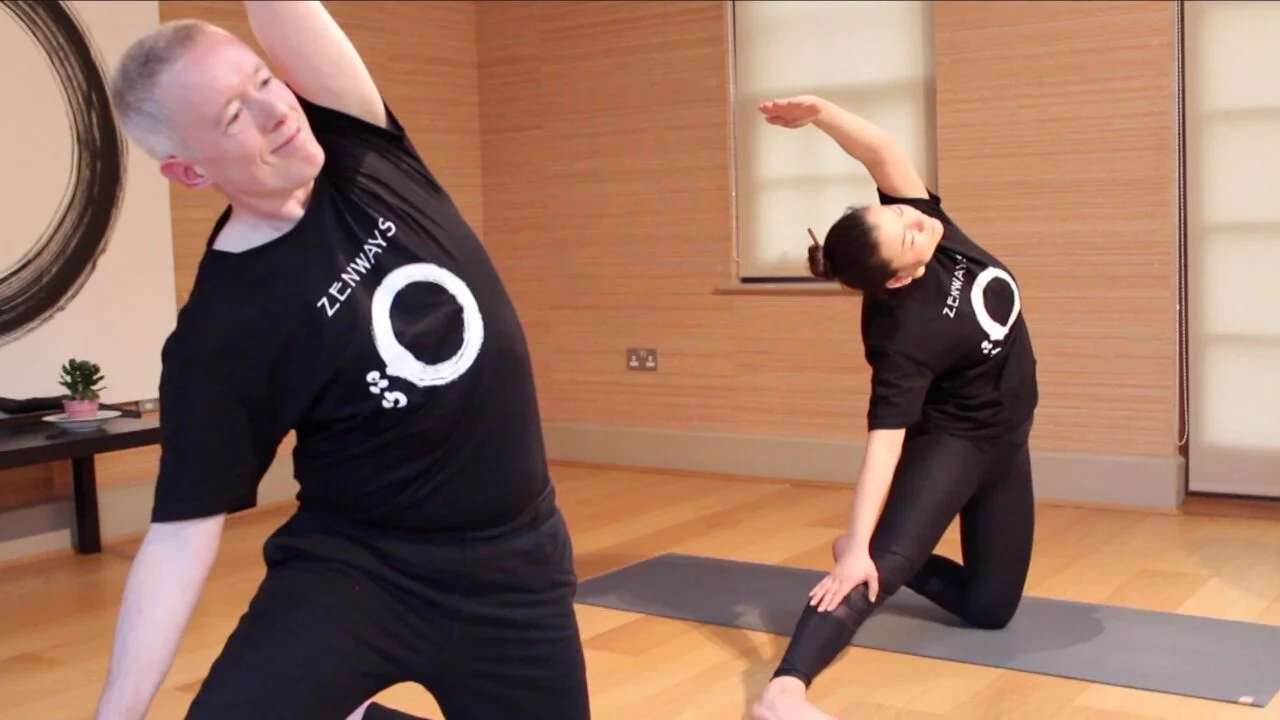
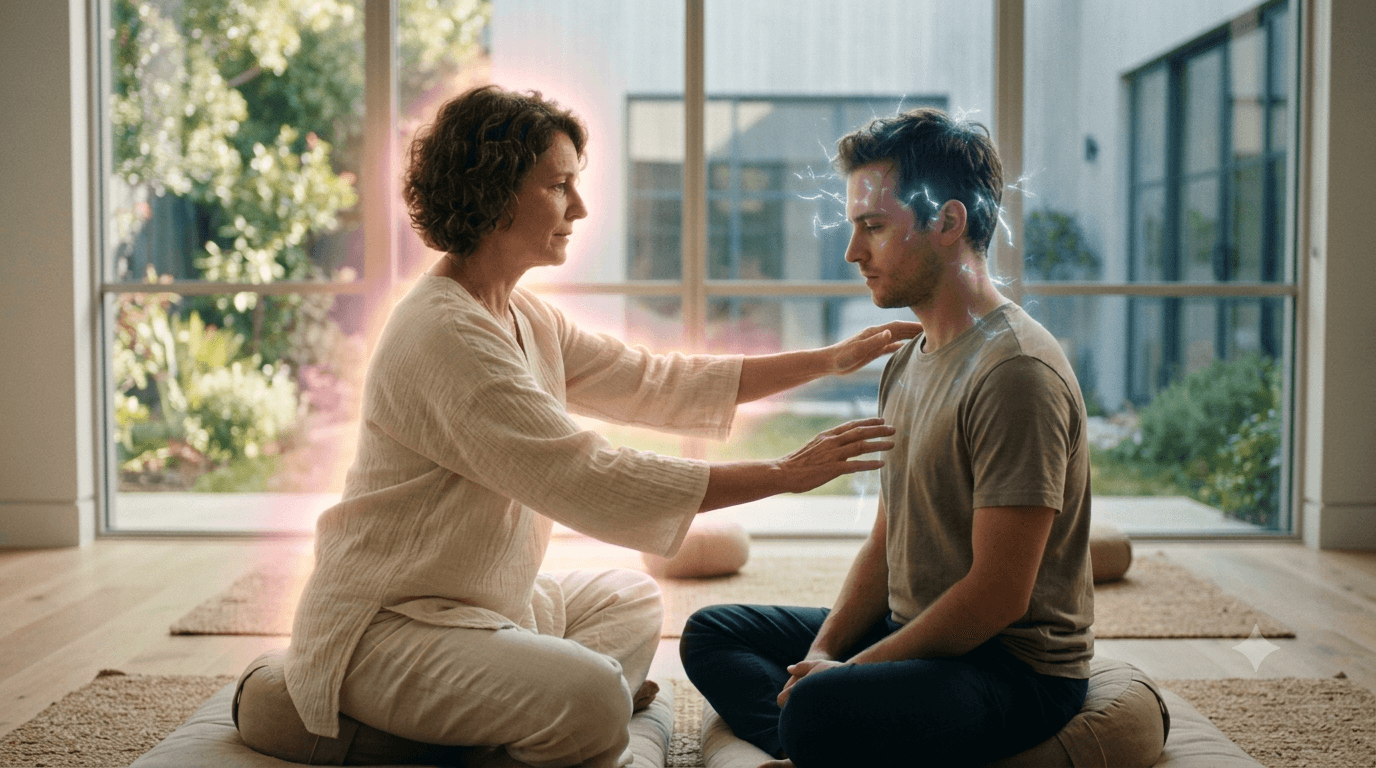
This is embodiment in the Zen sense. Not a technique you bolt on, and not a special somatic exercise you run at the end of a session, but the slow reorientation of a person’s whole presence around a new understanding, until that understanding becomes how they are rather than something they know.
It is present in the physical practice of yoga, clearly. But Daizan is careful to say it is equally present in the more mind based, noetic work. The distinction is not body against mind. It is lived against merely grasped.
Teaching through presence
Where this becomes most vivid is in how such knowing is passed on.
Daizan describes spending a week with one of the great Yamabushi, the mountain practitioners of Japan. The man was in his seventies. For the first four days he barely said a word. His teaching was simply how he moved through the mountains, his presence, his actual being. Only later did he begin to talk and explain.
His tea ceremony teacher, Ikawa Sensei, an eighty five year old woman, taught in the same way: through her presence and her being just as much as through any explanation or reasoning.
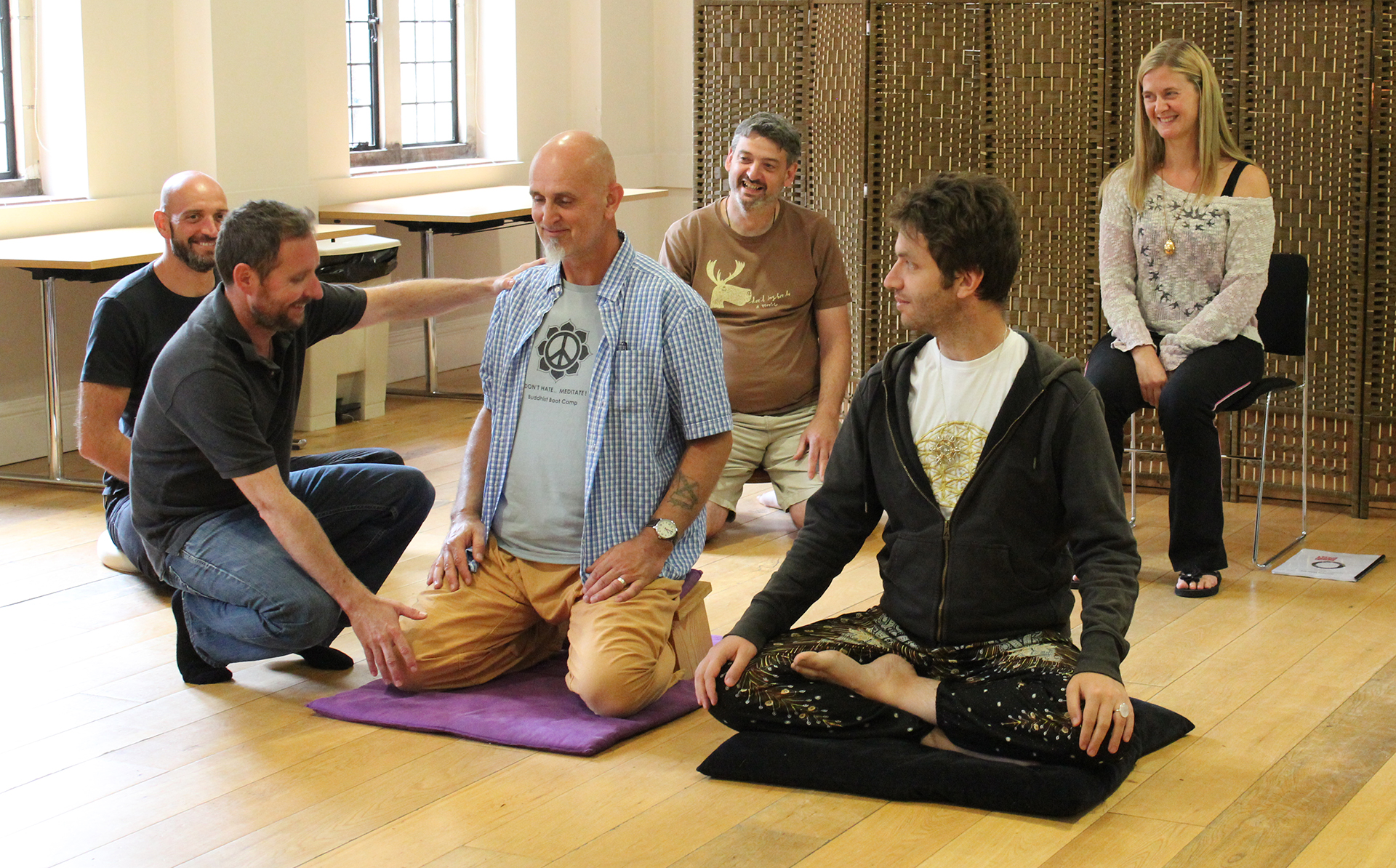
Anyone who works closely with others will recognise the truth in this. What we transmit most powerfully is rarely our technique or our clever formulation. It is the quality of our own presence. A settled nervous system settles the room. Real steadiness in the practitioner does more than any script. We can only truly offer others what we have embodied ourselves.
What this means for your work
This is the ground of The Embodied Mindfulness Way, the overarching approach that runs through Zenways’ professional training. It rests on a simple proposition with far reaching consequences: what you embody yourself, you can offer to others, and what you have only understood, you cannot.
For practitioners feeling the limits of purely cognitive approaches, this is not a call to abandon insight. It is an invitation to hold insight differently, to treat the flash of understanding as the opening of a longer process of embodiment rather than the finish line. It reframes your own development too. Deepening your practice is not a self indulgent detour away from the work. It is the work, because your embodied presence is the very instrument through which everything else is offered.
Going beyond the cognitive
There is a larger conversation opening up here, one we will return to in the blogs that follow: what it actually means to work beyond the cognitive, and how embodied practice meets people at the level of the nervous system, attention and lived experience rather than concept alone. Taitoku is the doorway into that territory, and it is one worth stepping through slowly.
If this resonates, and if you have felt the edges of working with the mind through the mind alone, you may find it worth exploring further. Zenways’ Mindfulness Pathway, created by Daizan Skinner, is built around exactly this principle. It is practice led, experiential, and rooted in a living Zen lineage, so that what you learn to hold for others grows from what you have lived yourself. Our free online introductory sessions are an unpressured place to sense whether this way of working speaks to you.
As Daizan puts it, our English word embodiment sums it up very nicely: taitoku. Realisation is nothing; actualisation is everything.
We offer professional, accredited training courses. Click these links to find out more: